Maritime intelligence from satellites and vessel tracks
Multimodal AI for mapping fishing vessels, filling gaps in vessel trajectories and monitoring recreational fishing.
Fisheries management depends on knowing where vessels are and what they are doing. Many vessels, however, switch off or never carry tracking transponders, and the tracks that do exist are full of gaps. This line of work combines satellite imagery, vessel tracking data and deep learning to give fisheries authorities a more complete picture of activity at sea.
What we built

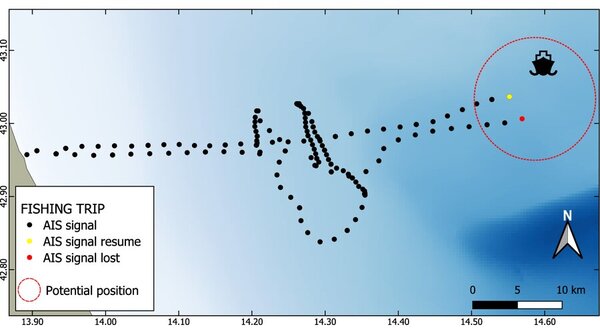
A fishing trip with a gap in the AIS signal: the vessel's position is lost and later resumes. Figure from Galdelli et al. (2025), Journal of Big Data, CC BY 4.0.
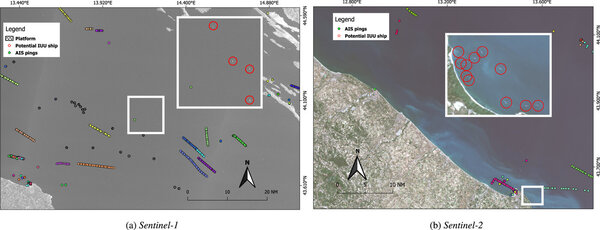
- Multimodal ship detection. A framework that fuses satellite imagery with tracking data to map fishing vessels and flag suspicious activities, published in Pattern Recognition Letters (Galdelli et al., 2025).
- Trajectory gap filling. BackForward Bi-LSTM, a model that imputes missing segments in large and small-scale spatiotemporal time series such as vessel tracks, published in the Journal of Big Data (Galdelli et al., 2025).
- Recreational fishers. A two-step approach that first detects and then classifies recreational fishers, a group that is rarely covered by official monitoring (Jose et al., 2025). I was the corresponding author.

Vessel detections on (a) Sentinel-1 and (b) Sentinel-2 imagery. Figure from Galdelli et al. (2025), Pattern Recognition Letters, CC BY 4.0.

Forward and backward imputation of a trajectory blackout with BackForward Bi-LSTM. Figure from Galdelli et al. (2025), Journal of Big Data, CC BY 4.0.
Community
In 2025 I organised the special session “Remote Sensing and Multimodal Data Fusion for Marine Applications Management” at IEEE MetroSea 2025 in Genoa, Italy.
References
2025
- PRL
 Multimodal AI-enhanced ship detection for mapping fishing vessels and informing on suspicious activitiesPattern Recognition Letters, 2025
- J. Big Data
 Data imputation in large and small-scale spatiotemporal time series gaps using BackForward Bi-LSTMJournal of Big Data, 2025
- ASME IDETCA Novel Two-Step Approach for Recreational Fishers Detection and ClassificationIn International Design Engineering Technical Conferences and Computers and Information in Engineering Conference, 2025


